
How Humanoid Robots Learn to Move: The Human Motion Capture Data Behind Embodied AI
Before a humanoid robot can walk across a room, lift a box, or work safely beside a person, it has to learn how. And almost always, it learns from a human first.
That is the quiet foundation of the entire humanoid robotics and embodied AI wave: real human motion, captured with precision, turned into the training data that teaches machines how to move. In this article we'll walk through how that data is made, why robotics and AI teams around the world depend on it, and how we produce it at Apple Arts Studios.

Why humanoid robots need human motion data
A humanoid robot is built to operate in a world designed for humans — the same doorways, stairs, tools, and workspaces we use every day. To do that, it has to move the way we move: balanced, adaptive, and natural.
Modern robot learning methods, especially imitation learning and reinforcement learning, are only as good as the motion data they train on. Feed a model clean, richly labeled human motion and it learns robust, generalizable behavior. Feed it thin or noisy data and it struggles the moment the real world varies. This is why human motion capture data for humanoid robots has become one of the most sought-after resources in physical AI — and one of the hardest to produce at quality and scale.

Inside the capture: recording human motion at scale
Producing motion data that a robot can actually learn from starts on the capture floor. In our studio, performers wear optical motion capture suits inside a camera-tracked volume, and every movement is recorded with sub-millimeter precision — full body, hands, and fingers.
What makes this genuinely useful for AI teams is scale and variety. We capture multiple performers simultaneously in a single volume, which unlocks the cooperative and multi-agent motion that most datasets simply don't contain. Walking, running, turning, balancing, reaching, lifting, carrying, interacting with objects and with each other — the everyday actions a humanoid robot must master before it can operate around people.

From raw motion to robot-ready data
Capture is only the first step. Raw motion has to be cleaned, structured, and made usable before any AI team can train on it. Our production pipeline turns performance into training-ready data:

Capture → Cleaning → Retargeting → Robot conversion → Labeling → Delivery.
Every clip is cleaned of noise and gaps, retargeted to the skeleton the customer needs, and labeled with the action and metadata that make it searchable and trainable. The result is data an engineer can drop straight into a learning pipeline.

Formats we deliver
Robotics and AI teams work in different stacks, so we deliver in the formats your pipeline actually uses:
Motion data: BVH, FBX, C3D, TRC, CSV, NPZ, JSON
Robot formats: Unitree G1, Unitree H1, SOMA BVH, retargeted and custom skeleton mapping
Video: synchronized multi-camera RGB, witness cameras, reference video (MP4)
Metadata: performer profile, action labels, calibration data, synchronization and frame metadata, object data
This is what separates a usable dataset from a nice-looking render: complete, labeled, engineering-grade data with the reference material to back it up.

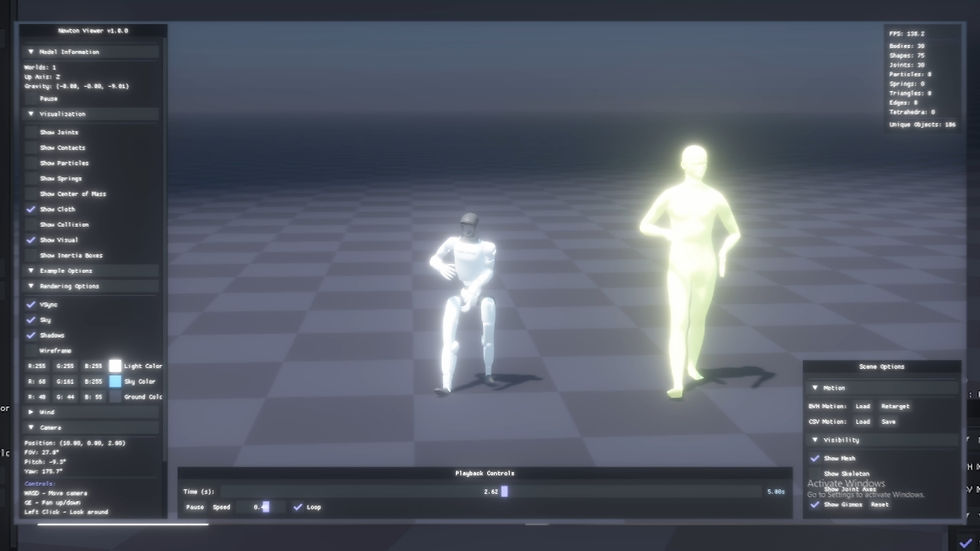
Our custom pipeline and in-house tools
Delivering data this clean, this consistently, and at this scale isn't something off-the-shelf software does on its own. Over years of production we've built our own custom motion capture pipeline and a growing suite of in-house tools that automate the entire path from raw capture to training-ready output.
That pipeline generates clean metadata JSON, SOMA Uniform BVH, Unitree G1 CSV, and retargeted skeletons automatically — no manual, one-off conversions that introduce errors and slow everything down. It's how we keep quality consistent across hundreds of files and turn large-volume projects around quickly.
Just as important, the tooling is flexible. When a robotics or AI team needs a new format, a different skeleton mapping, a specific metadata structure, or a data layout tailored to their training framework, we build the tool for it and fold it into the pipeline. In other words, we don't force your data to fit our process — we engineer the process to fit your robot and your pipeline. That combination of production-grade capture and custom data engineering is what lets us deliver exactly what each customer needs, reliably and at scale.

Custom motion datasets for robotics and AI teams
Most of our work is custom. Every robot platform is different, and every training objective is different, so we design and capture datasets around each customer's specific actions, morphology, and learning goals — from a focused pilot to large-scale production.
Whether you're training a humanoid to walk, to manipulate objects, to keep its balance on stairs and ramps, or to work cooperatively alongside people, we capture the exact human motion your model needs and deliver it ready to train.
Try a free sample dataset
We've published a free 5-hour production sample on Hugging Face so robotics and AI teams can evaluate our capture quality, data organization, metadata, and delivery formats before starting a conversation. It's intended for technical evaluation — a real look at how we structure motion data for robot learning.

Who we are
Apple Arts Studios is a production motion capture studio serving robotics, embodied AI, film, gaming, and virtual production. For over a decade we've captured human motion for the screen; today that same capability produces the human motion datasets that train the next generation of humanoid robots — for teams across India, the United States, Europe, and worldwide.

Frequently asked questions
How do humanoid robots learn to move? Humanoid robots learn to move largely from human motion capture data. Real human performances are recorded, cleaned, retargeted to the robot's skeleton, and used to train imitation-learning and reinforcement-learning models so the robot can reproduce natural, balanced movement.
Where can robotics companies get human motion capture data? From a production motion capture studio that can capture, clean, retarget, and label motion at scale. Apple Arts Studios produces custom human motion datasets for humanoid robotics and embodied AI, delivered in formats such as BVH, Unitree G1 CSV, and custom skeletons with full metadata.
What formats is motion capture data delivered in for AI training? Common formats include BVH, FBX, C3D, TRC, CSV, NPZ, and JSON, plus robot-specific formats like Unitree G1/H1 and custom retargeted skeletons, alongside synchronized reference video and metadata.
Can motion capture datasets be customized for a specific robot? Yes. Custom datasets are designed around a specific robot platform, its morphology, and the exact tasks it needs to learn — captured to spec and retargeted to the robot's skeleton.
What is imitation learning in robotics? Imitation learning is a method where a robot learns behavior by imitating demonstrations — often human motion capture data — rather than being programmed action by action. High-quality, labeled human motion data is essential to it.
How is motion capture data converted into robot-ready formats? Through a data pipeline that cleans, retargets, and labels captured motion, then exports it to the required formats. Apple Arts Studios uses a custom in-house pipeline and toolset to automatically generate metadata JSON, SOMA BVH, Unitree G1 CSV, and retargeted skeletons — and builds new tools when a customer needs a specific format, skeleton mapping, or data structure.
Build your robot's motion dataset with us
If you're building a humanoid or training an embodied-AI model and you need real, production-grade human motion data, let's talk.
Apple Arts Studios — the human motion behind humanoid robots.