
Your Robot Needs Data. Every Format. Every Pipeline. — Motion Capture Data for Humanoid Robots

Every robotics team we talk to asks the same first question: what formats do you deliver?
It's a fair question — because the best capture in the world is worthless if the data lands in a shape your training pipeline can't use. Between BVH and FBX and CSV and NPZ and every custom skeleton, format is the quiet gatekeeper between a motion capture session and a robot that actually learns from it.
So here's how we think about it at Apple Arts Studios — and exactly what we deliver.
We don't just capture. We deliver to your pipeline.
There's a difference between handing a team a folder of raw mocap and delivering training-ready data that plugs straight into their learning stack. The first still needs conversion, cleaning, and structural work on the buyer's side. The second is what a robotics engineer can load and use on day one.

Everything we produce goes through our own in-house pipeline and toolset — the one we built over 15+ years of AAA film and game work — and it now generates every format a modern robotics or AI pipeline uses, automatically and at scale.
The formats we deliver
Motion formats, robotics-ready formats, and ML-pipeline formats. Grouped so it's clear which fits where.
Motion formats
Motive BVH — clean skeletal motion straight from our capture pipeline
Motive CSV — joint data in tabular form
FBX — the industry-standard exchange format for animation and DCC tools

Robotics-ready formats
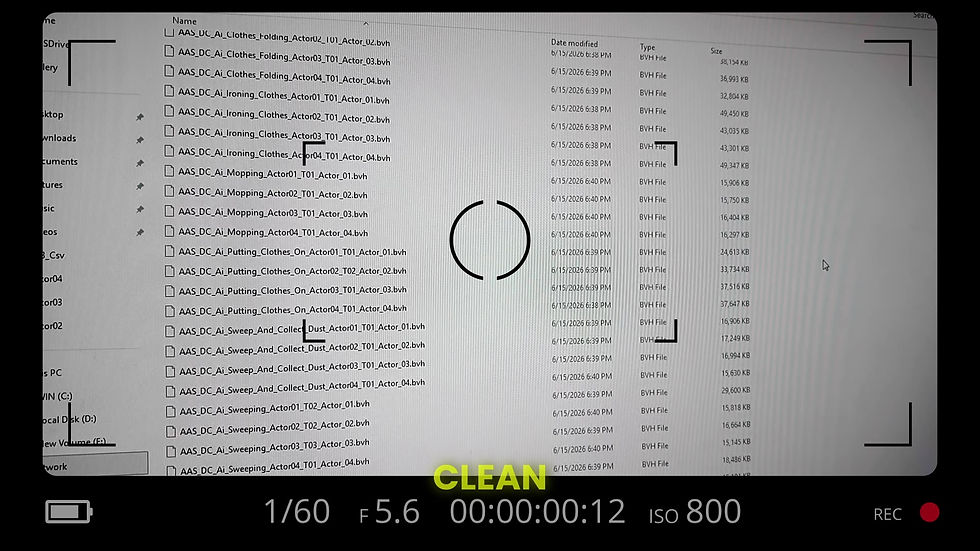
SOMA BVH — uniform BVH structure ready for retargeting to humanoid platforms
Unitree G1 CSV — joint data mapped directly to the Unitree G1
Metadata JSON — per-clip metadata with action labels, performer profile, capture parameters, and object data

Motion capture metadata JSON with action labels and performer information
ML and AI pipeline formats
NPZ · NPY — NumPy binary arrays, ready to load in Python training pipelines
PKL — Python-pickled objects for structured datasets
Parquet — columnar storage format optimized for large-scale ML workflows
Annotations — we're actively rolling these out; per-clip action, phase, and object-interaction labels layered on top of the motion data.
Why the format list actually matters
If a robotics team runs on NPZ, they don't want to convert BVH. If they train on Unitree G1, they don't want to retarget skeletons manually. If their model consumes JSON action labels, "you can figure it out from the filenames" isn't a delivery.
Meeting the pipeline where it lives is the difference between data that starts training on day one and data that sits in a to-do list for two weeks.

Also: full-body, hands, object interaction, multi-actor
The formats above cover the full range of what we capture — full-body motion, hand and finger detail, object interaction, and multi-actor performance, all in the same delivery when the project needs it. Same pipeline, same clean output, whichever combination your robot's learning objectives require.

Try a free sample
We publish a free 5-hour production sample dataset on Hugging Face so robotics and AI teams can evaluate our data structure, formats, and metadata quality before starting a conversation.
Frequently asked questions
What motion capture formats do you deliver for humanoid robotics? Motive BVH, Motive CSV, FBX, SOMA BVH, Unitree G1 CSV, metadata JSON, NPZ, NPY, PKL, and Parquet. Custom skeletons and retargets on request. Annotations are actively rolling out.
Which robots do you retarget motion to? Unitree G1 is directly supported. We retarget to other humanoid skeletons on request as part of custom capture.
Do you support ML-pipeline formats like NPZ and Parquet? Yes. We deliver NPZ, NPY, PKL, and Parquet alongside standard motion formats so the data loads directly into Python training pipelines.
Can you deliver a custom format for our specific pipeline? Yes. We built our own pipeline and toolset in-house, and we extend it whenever a team needs a specific format, skeleton mapping, or metadata structure.
Do the files include action labels and metadata? Yes. Every clip carries a metadata JSON with action labels, performer profile (height, weight, age, gender), capture parameters, and object data where relevant. Structured annotation layers are actively rolling out.
Tell us your format
If you're building a humanoid or training an embodied-AI model, don't ask if we support your format. Ask us to deliver in it.
